

News
Bringing Advanced Human Biology into Drug Development with MIMETAS
MIMETAS is a biotech company combining biological and engineering expertise to develop advanced, scalable human tissue models. These human disease models provide a user-friendly way for researchers and drug developers to incorporate complex human biology into experiments from an early stage. MIMETAS offers access to their models through Oncode Accelerator’s translational research ecosystem, creating new opportunities for oncology innovation.
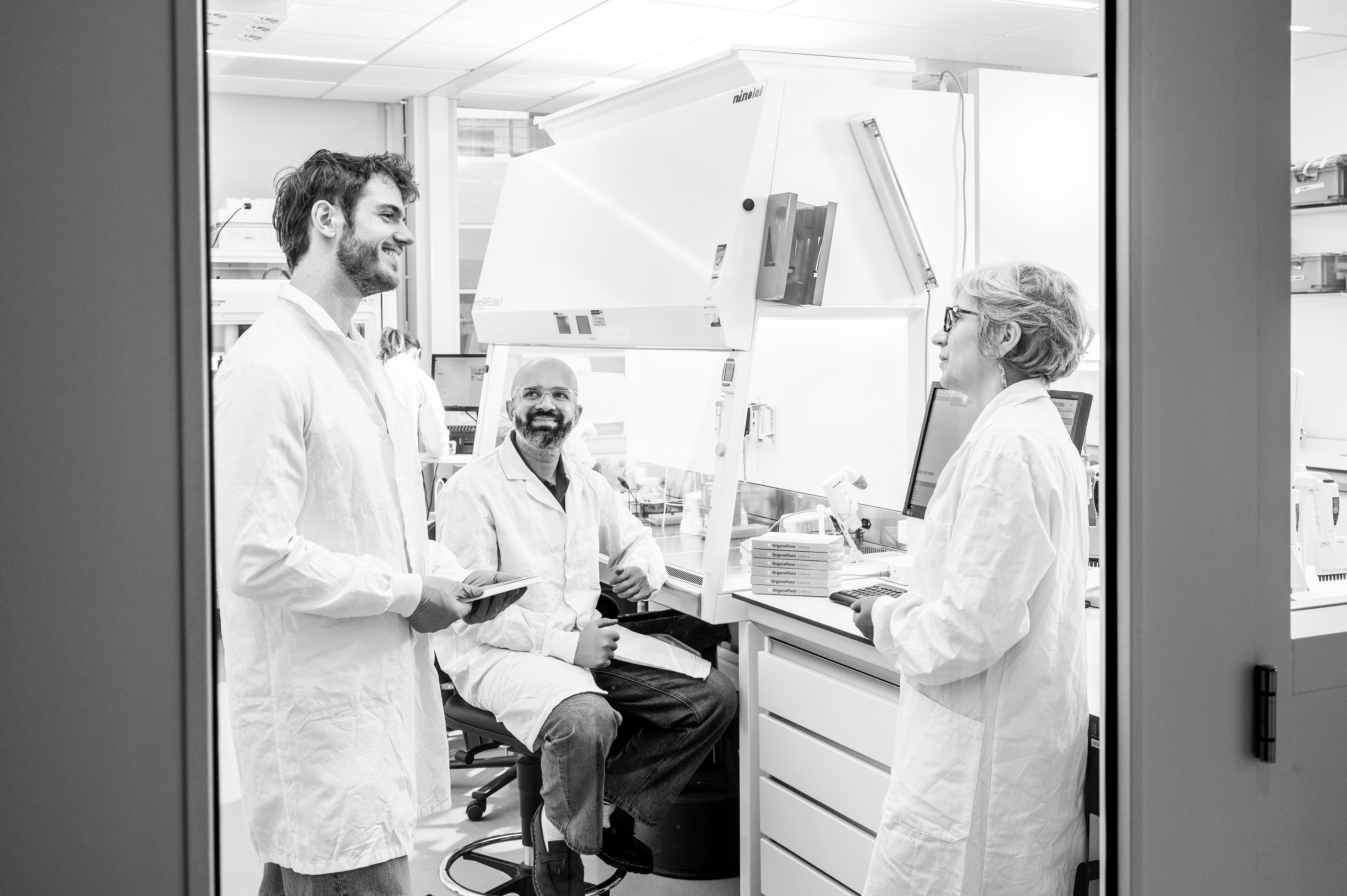
For over a decade, MIMETAS has been leading the field in human tissue modeling. Originally focused on developing organ-on-a-chip platform technologies, MIMETAS has evolved into a leading provider of advanced human disease models and contract research services for pharmaceutical and biotechnology companies worldwide. The company is a long-standing member of Oncode Accelerator’s Organoids Platform, contributing to the development and validation of user-friendly advanced human tissue models to accelerate oncology drug development. We spoke with Bas Trietsch, co-founder and Chief Technology Officer at MIMETAS, and Henriëtte Lanz, VP of Biology, to learn more.
Accessible Advanced Human Tissue Models
"Our ambition has always been to push the boundaries of what human biology models and microfluidics can do," says Bas. "Because we both build and use our technology platforms, and have a team of great stem cell biologists, developmental biologists, organoid experts, engineers, and data scientists, we can pinpoint places where existing scientific models can’t provide answers yet and quickly innovate to fill those gaps. This flexibility is a core strength of MIMETAS.”
Bas Trietsch, co-founder and Chief Technology Officer at MIMETASOur ambition has always been to push the boundaries of what human biology models and microfluidics can do.
MIMETAS also prioritizes user-friendliness. “Many people still see organoids as a complicated model that’s difficult to work with,” reflects Bas. “But one of the foundational design approaches of MIMETAS is that our plates should be easy to use, even though they are high-tech." Henriëtte adds: “As long as you can pipette in the middle of a well in a 384-well plate, you can work with our models.”
MIMETAS' core technology offering is the OrganoPlate®: a microfluidic platform that enables researchers to culture a wide range of human cells and complex tissues within a standard microplate format. The platform supports a high level of biological complexity in a format suitable for running high-throughput assays. To build their models, MIMETAS draws on their own biobanks as well as the biobanks of healthy and tumor tissues co-developed with Oncode Accelerator partners. Together, these biobanks are representative of many different organs, and include not only primary functional cell types but also supportive cells such as resident immune cells and fibroblasts.
Importantly for oncology research, OrganoPlate® technology enables the creation of vascularized tissues containing multiple cell types, including epithelial cells, stromal components, connective tissue, and immune cells. Each OrganoPlate® uses patented PhaseGuide™ technology instead of artificial membranes, allowing cells to interact freely with each other within perfused extracellular matrix environments. The technology is therefore well suited for studying biological processes that are difficult to model using conventional in vitro approaches or classical spheroids and organoids, such as immune cell recruitment, tumor invasion, and metastasis.
Henriëtte explains: “After we put the cells in place on the OrganoPlate®, they’re locked in place in the extracellular matrix. Then, tissues form by themselves, and cells can still migrate from one compartment to another. We can also build out larger tissues in multiplex systems, all within the confines of the plate. And because we have healthy components present, sometimes even within the same model, we can assess if therapeutics affect the healthy cells or only tumors.”
“We offer best-in-class biology with unparalleled complexity and maintenance of tissue architecture without sacrificing throughput,” Bas summarizes. “Testing fifty thousand compounds or generating a hundred thousand data points is completely doable, and is not cost-prohibitive, with our technology.”
Collaborating to Advance and Apply New Approach Methodologies
MIMETAS has several long-term partnerships across academia and life science companies that are focused on advancing and applying human disease modeling. An example: within their partnership with Astellas Pharma, MIMETAS supported the setup of an end-to-end, automated pipeline in the Astellas labs for advancing immuno-oncology therapies. “The fact that Astellas has worked on this with us for years, and that they have made significant investments in bringing our models in-house and rolling them out at scale shows that this is core to their strategy,” Bas comments. Another strong vote of confidence in MIMETAS’ approach and models recently came from Bruker. In August 2026, the Bruker Corporation announced a majority investment into MIMETAS to advance human physiology-relevant drug discovery and development.
Within oncology, MIMETAS focuses especially on supporting investigation of interactions between tumors and their microenvironments, and the influence that therapies have on those processes. Henriëtte elaborates: "We have a beautiful platform to show how advanced drugs like T-cell engagers, antibody-drug conjugates (ADCs), CAR T cells, or other advanced medicinal products (ATMPs) work in a human tissue model with vasculature and immune components. Because many advanced cancer therapies, including immunotherapies, depend specifically on human biological mechanisms, animal models often have limitations. Our human tissue models can provide insights that are difficult or impossible to obtain otherwise. When working with animal models, you might sometimes see a lack of efficacy or toxicity with your candidate therapy, but have reason to believe that it is animal-specific. Our models help you to confirm or deny that hypothesis.”

Henriëtte Lanz, VP of Biology at MIMETASWe have a beautiful platform to show how advanced drugs like T-cell engagers, antibody-drug conjugates (ADCs), CAR T cells, or other advanced medicinal products (ATMPs) work in a human tissue model with vasculature and immune components.
Henriëtte provides an example of how a pharma partner has used their assays to identify human-specific side effects that are not adequately represented in conventional animal models: “Peripheral neuropathy is a potential negative side effect of some oncology drugs. We set up an elegant and straightforward assay to allow you to assess if candidate ADCs damage nerve endings in a human tissue model. AstraZeneca has used that assay to rank candidates.”
Bas provides another example: “We also validate in our own models. For instance, we performed a validation study of our colon organoid tubules as a healthy model for assessing side effects such as diarrhea. It showed that our model’s sensitivity is higher than conventional, gold standard models.”
As governmental expectations and regulatory acceptance for the use of new approach methodologies (NAMs) like organoids intensify, MIMETAS expects increased demand for their models and services. “We see that companies are starting to build valuable datasets using NAMs, which will help convince governmental and regulatory authorities of the case for their drug candidates later on,” Bas states. Underlining the OrganoPlate® platform’s utility in these efforts, MIMETAS has already contributed to an IND application by argenx with human organ-on-a-chip data.
Building Scalable Oncology Infrastructure with Oncode Accelerator
For MIMETAS, a key benefit of working with Oncode Accelerator is being embedded into a consortium with a wide range of oncology experts, alongside access to valuable patient-derived tissues, and associated data. “It helps us stay on the bleeding edge of modeling more tumor types, and maintain access to both patient material and associated clinical information,” explains Bas. “This is crucial for setting up novel models, including for rare diseases. Strategic partnerships that leverage Oncode Accelerator’s Patient Cohorts Platform can also help us learn from clinical outcomes to develop new treatments sooner and more efficiently.”
Henriëtte elaborates: “That means that we can also onboard new tumor or tissue types to develop built-for-purpose models within Demonstrator Projects, for instance for specialized screening work.”
"As part of Oncode Accelerator, we are not just developing the models – we are also building the infrastructure," adds Bas. "That means that we have the infrastructure ready for researchers that want to screen a large number of compounds on a wide biobank of tumor types, at significant throughput."
Bas Trietsch, co-founder and Chief Technology Officer at MIMETASWe have the infrastructure ready for researchers that want to screen a large number of compounds on a wide biobank of tumor types, at significant throughput.
A Call for Innovative Demonstrator Projects
Within the Oncode Accelerator oncology ecosystem, MIMETAS supports R&D through Demonstrator Projects: collaborative preclinical development projects that use Oncode Accelerator’s integrated infrastructure. Drug developers from around the world can apply to work with MIMETAS and other Oncode Accelerator partners, and receive co-funding for their projects.
MIMETAS is actively seeking Demonstrator Projects that apply the power of advanced human tumor models in translational research. Projects focused on immuno-oncology, tumor microenvironment biology, and human-specific therapeutic mechanisms are particularly welcome. MIMETAS invites scientists who are interested in evaluating safety, efficacy, or therapeutic mechanisms in advanced human tumor models to apply for a collaborative Demonstrator Project.
"One of our greatest strengths is in combining vascularized human tumor models with immune components," says Henriëtte Lanz. "If researchers are developing innovative immunotherapies and want to understand how those therapies behave in a complex human tissue environment, that's exactly the type of challenge we would like to tackle together."
Bas adds: “We already have a nice ongoing collaboration with academic partners within the Oncode Accelerator Organoids Platform, which is looking at the effect of the tumor microenvironment on metastasis. I would also love to build on that work.”
Ultimately, MIMETAS shares Oncode Accelerator's ambition to bring better therapies to patients faster. "We have built the infrastructure," says Bas. "Now we want to put it to work. The ideal outcome is a continuous pipeline of innovative oncology Demonstrator Projects using advanced human tissue models to generate the data needed to make better therapeutic decisions, and accelerate the development of new cancer treatments."
MIMETAS (Leiden, The Netherlands) is a global leader in human-relevant disease models for drug discovery and development. Based on its proprietary OrganoPlate® platform, MIMETAS has developed a broad spectrum of disease assays with unrivalled physiological comprehensiveness. The company deploys its disease models in partnerships with the global top-50 pharmaceutical industry to find and develop first-in-class targets and compounds. MIMETAS was founded in 2013 in Leiden, the Netherlands, and has grown into a multinational company with operations in Europe, Asia, and the USA. To learn more about MIMETAS's disease modeling capabilities and its OrganoPlate® platform, please visit www.mimetas.com.