

News
Cancer vaccine facility opens at the Princess Máxima Center for pediatric oncology
Researchers in the Princess Máxima Center for pediatric oncology can now look for starting points for the development of new cancer vaccines. With the opening of the lead finding facility there, an important milestone within national partnership Oncode Accelerator has been reached.
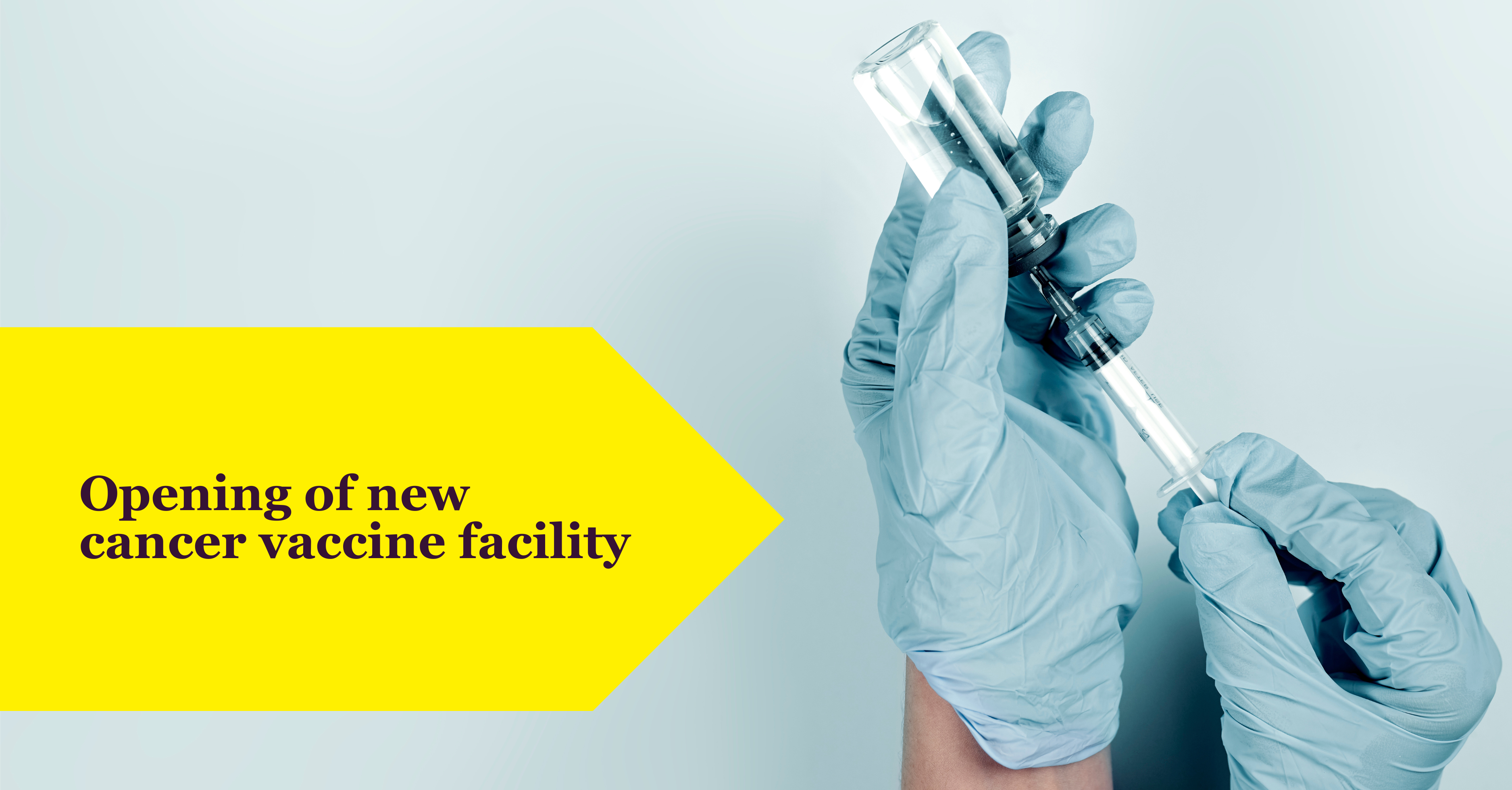
Therapeutic vaccines, in combination with other therapies, are a promising form of immunotherapy for the treatment of cancer in children and adults. The vaccines 'train' the immune system to recognize cancer cells as foreign and then attack the tumor. Therefore the development of new cancer vaccines is one of the key focuses of Oncode Accelerator.
Comparing billions of data points
The first step in developing a vaccine is to find the recognition point needed to train the immune system. This is a protein that sits on the outside of the cell and is also called an antigen. The production of this protein is controlled by the genetic code, the DNA and RNA, in the cell.

Sebastiaan van Heesch, Workstream Lead Therapeutic Vaccines at Oncode AcceleratorBy bringing together the latest technology and specialists, we are accelerating the development of new cancer vaccines.
Simon Venneman, project manager in the Van Heesch group and involved in the research: 'DNA consists of 3 billion letters. By comparing DNA from tumor and normal cells, we hope to find landmarks. The difference between cells can be in just a few letters. With one of the two new devices, the Nanopore PromethION 24, we can map the genetic code very accurately. This is because, compared to common methods, it reads long strands of the code in a single pass. We can directly compare the billions of data points we find using specially developed computer programs based on artificial intelligence (AI). This is how we find the antigens that can serve as starting points for a vaccine.'
Validation
The researchers are using a second device to make sure that a DNA difference actually causes a protein on the cancer cell. 'With the Bruker TimsTOF Ultra, we are taking an important step. Whereas with the first device we try to find evidence of possible antigens, with this second device we can show that this antigen is actually produced in cells and is recognizable by the immune system. This is essential information to actually develop a cancer vaccine,' Venneman says.
Together with Prof. Dr. Albert Heck of Utrecht University, also co-lead of the Oncode Accelerator Therapeutic Vaccines Workstream, this validation step is being carried out. An identical device has also been placed at Utrecht University to make optimal use of the knowledge of the Heck lab to generate detailed data. Also of the very smallest proteins. In addition, this allows twice as fast working and learning from everyone's experiences.
Simon Venneman, project manager Van Heesch groupWith the Bruker TimsTOF Ultra, we are taking an important step. Whereas with the first device we try to find evidence of possible antigens, with this second device we can show that this antigen is actually produced in cells and is recognizable by the immune system. This is essential information to actually develop a cancer vaccine
Flywheel
Having all the equipment in one place has many advantages explains Dr. Sebastiaan van Heesch, research group leader at the Máxima center, Junior Investigator at Oncode Institute and co-lead of the Therapeutic Vaccines Workstream of Oncode Accelerator: 'Thanks to the new facility, we don't have to send material and transfer research to a party outside the Máxima, which saves time. We will also see and learn for ourselves where we can further improve the analyses and the process. This way, we will significantly speed up the process of arriving at starting points for new vaccines.'
Next steps
Prof. Sjoerd van der Burg, professor of immunotherapy and solid tumors at Leiden UMC, Senior Oncode Institute investigator and co-lead of the Therapeutic Vaccines Workstream of Oncode Accelerator adds: 'The opening of this facility is an important milestone. At the Máxima center, the first step is taken with the identification of specific antigens, after which we can determine within our working group which of these antigens are capable of eliciting a response from the immune system, in order to then design and test the most optimal vaccine possible in patients. It is very nice that the chain has now been set in motion to arrive at new vaccines for the treatment of cancer in children and adults.'
Source original article:
About Princess Máxima Center:
Around 600 children in the Netherlands get cancer every year, and one in four children who are diagnosed with cancer dies from this illness. When a child is seriously ill with cancer, only one thing comes first: cure. That is why at the Princess Máxima Center for pediatric oncology we work together every day in a groundbreaking and passionate way to improve the survival rate and quality of life of children with cancer. Now, and in the longer term. Because children still have a whole life ahead of them. The Princess Máxima Center is not an ordinary hospital, but a research hospital. All children with cancer in the Netherlands are treated here. This makes the Princess Máxima Center the largest pediatric cancer center in Europe. Over 450 researchers and 900 healthcare professionals work closely with Dutch and international hospitals on better treatments and new perspectives on cures. In this way, we give the child of today the very best care and take important steps to improve the chances of survival for the children who are not yet cured.