

News
From Complex Chemistry to Clinical Trials: Spotlight on Symeres
Symeres is a transatlantic CRO/CDMO with expertise spanning early discovery to GMP drug substance and drug product capabilities. The company also has deep experience in the development of small molecule-based therapeutics. In the context of cancer therapies, Rutger Folmer, Director Medicinal Chemistry at Symeres, is no stranger to the complexities and long timelines involved in bringing a drug from an early-stage idea all the way to clinical trials. By sharing his expertise as a partner within the Oncode Accelerator cancer research and development ecosystem, Rutger hopes to help scientists overcome those challenges.
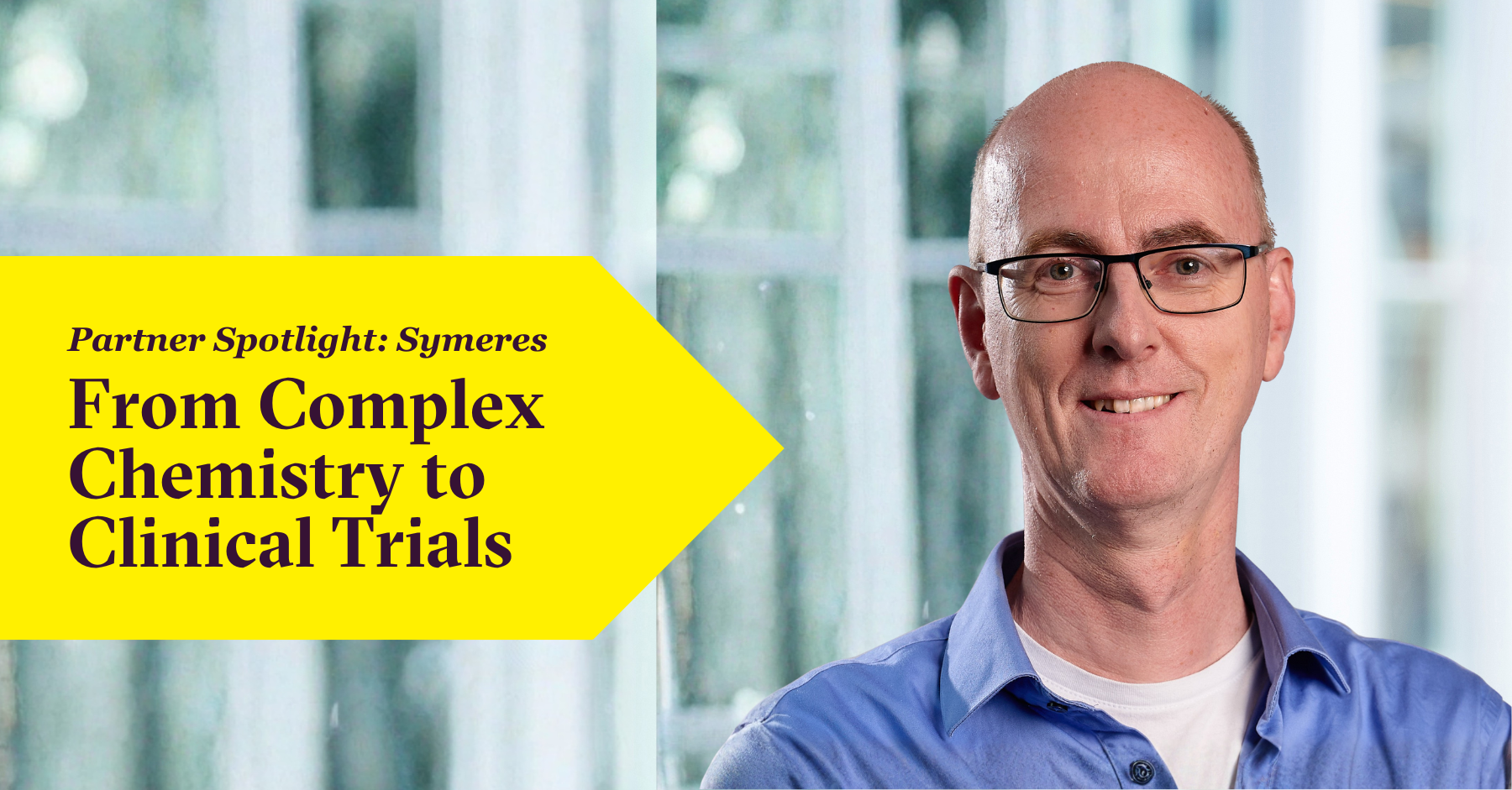
In the challenging field of small molecule drug discovery and development, Rutger Folmer derives much of his professional satisfaction from the nitty gritty details of steadily moving challenging projects forward – one step at a time. Rutger explains: “What I like best is using my expertise and experience to proactively solve issues that a drug discovery program may have. Drug discovery is a very complex puzzle, and I know by now what works and what doesn’t work. I can use that knowledge and expertise to drive forward projects for Symeres’ customers. That’s what makes me tick.”
Design-Make-Test-Analyze
At the core of medicinal chemistry, and Symeres’ approach, is the so-called “Design-Make-Test-Analyze” cycle: an iterative process that zooms in on one step of drug discovery at a time, slowly improving upon an initial small molecule until it reaches the clinical stage. Rutger explains: “Using the Design-Make-Test-Analyze cycle, we design molecules to become increasingly better, potent, and more stable. It works like this: you design something, you synthesize it, you test it in a specific assay, you analyze the results, and then you design the next round based on those new insights. You go around iteratively in that cycle, where each round takes two weeks. In each round, we make ten to thirty new molecules that are then tested again. As the project becomes more advanced, so do the tests. You start to test for things like metabolic stability, safety, activity in cellular assays, and eventually efficacy in vivo.”
It sounds easy, but in reality each step is a complex puzzle – and scientists often encounter setbacks. “And for a small biotech,” adds Rutger, “a setback like that can seem like the end of the world.”
The Big Picture of Small Molecules
No plan can be perfect, so completely preventing project setbacks is very difficult – but Symeres has a lot of experience in handling them. They operate so that they proactively tackle challenges before they arise, pivot quickly when needed, and apply their knowledge across all stages of drug discovery and development to minimize program risk. “We’ve seen all kinds of setbacks, so we can anticipate solutions, identify new opportunities, tweak compounds quickly, and crunch on,” says Rutger.
Rather than any one instrument or assay, according to Rutger it’s this big picture understanding of the science, the processes, and the many decisions made over the course of a drug discovery and development program that is Symeres’ true strength.
Rutger explains: “In a project, we make thousands of decisions about what to prioritize, what assay to use to get the right data, and so on. If over a thousand decisions, you make those decisions even a few percentage points better than others, you can progress much faster. That’s where our expertise lies — we feel very comfortable in making those decisions that drive forward projects. It’s not because we have a silver bullet or one special trick. We have a whole bag of tricks. We know that this proactive decision making is valued by our customers and leads to them returning for future projects. That suggests that we must be doing something right.”
Rutger Folmer, Director Medicinal Chemistry at SymeresIn a project we make thousands of decisions about what to prioritize, what assay to use to get the right data, and so on. If over a thousand decisions, you make those decisions even a few percentage points better than others, you can progress much faster.
This combination of deep scientific expertise and practical problem-solving aptitude makes Symeres an ideal partner within Oncode Accelerator’s Demonstrator Projects. These projects – which are open for applications from drug developers worldwide – aim to accelerate the preclinical development of promising novel cancer therapies. Chances of success are improved through collaboration with partners who understand how to turn promising molecular concepts into viable therapeutic candidates. Symeres’ capabilities provide a strong foundation for that transition. For researchers applying for a Demonstrator Project, this means access to experienced scientists who can help refine experimental designs, troubleshoot complex chemistry challenges, and ensure that promising molecules are developed with clinical feasibility in mind.
The Long Road From Concept to Clinic
Having a bag of tricks spanning the whole pipeline is important, considering the large ‘valley of death’ looming within the statistics for successful development of small molecule therapeutics. “People can be working in this field for their whole career without anything they worked on getting on to the market,” says Rutger. “Our mission as a company is to help our clients have a better chance of success in that. We offer a lot across the whole discovery and development pipeline — we can work all the way to phase II and sometimes even to Phase III clinical trials. It’s all with the focus of enabling others.”
The company is also starting to increasingly focus on regulatory affairs, for instance with their acquisition of DGr Pharma. Symeres envisions that this will help support partners all the way through to the end of the development pipeline. Nonetheless, Rutger cautions scientists to stay realistic: “Projects take much longer than people think — it typically takes about 8 years from concept to clinical candidate.”
Why does the process of small molecule development take so long? Rutger gives an example of a common challenge. “In the discovery stage, you work with very small amounts of molecules — sometimes only milligrams, sometimes less. Then if you want to do a case study in a mouse, you might need 200 to 400 milligrams. But at some point, you will want to perform bigger toxicity studies or go to clinical trials. Then you need grams or kilograms of your compound. Just the process of upscaling alone can be a year of work. You might think, ‘If I make 20 milligrams, I’m sure I can make a kilogram’ — but this is not a given.” With different volumes, the underlying chemistry can drastically change. This is why Symeres considers scale-up early in discovery: to ensure that late-stage failures are minimized.
Shortening this long road from concept to clinic is one of the main goals of Oncode Accelerator, and is accomplished through integrating at least one of our Innovation Platforms – well-defined Patient Cohorts, Organoids, and AI – into every Demonstrator Project. By implementing these advanced technologies within preclinical development pipelines, Oncode Accelerator aims to build that robust foundation of data, strengthen decision-making, and ultimately make preclinical development more predictive and efficient. In service of this goal, partners who successfully apply for a Demonstrator Project gain access to the technology, infrastructure, and expertise of our Innovation Platforms.
Rigorous Science, Impactful Collaborations
When asked about his number one tip for scientists aiming to develop a novel small molecule cancer therapy, Rutger argues that putting in more effort up-front will pay off later on: “The quality of assays run is tremendously important — more important than people tend to believe. We see a lot of companies coming to us with hits that turn out not to work. I think that in nine out of ten of those cases, it’s because the assay used for discovery wasn’t properly set up. People tend to like to screen a bigger library of compounds than to put a lot of effort into a good, robust assay on a smaller library. You don’t have to screen an enormous library – if it’s a good assay without artifacts, you can screen a smaller library and get promising hits.”
By working within Oncode Accelerator, Rutger hopes that the accumulated expertise within Symeres can be used. “I see Oncode Accelerator as a platform to help us to share our expertise with drug developers – to help them to work more effectively, get to the next stage in their work, and maybe bring products to the market. That’s the reason I’m doing this: to help other scientists.”
About Symeres
Symeres is a transatlantic partner for small molecule drug discovery and development, guiding programs from the first spark of discovery through to clinical development and manufacturing. Within Oncode Accelerator, Symeres is embedded in the Small Molecules Workstream, and supports Demonstrator Project Partners with preclinical discovery and development of small molecule-based cancer therapeutics. With eight locations across Europe and North America and more than 30 years of industry experience, Symeres combines deep scientific expertise with an agile, collaborative mindset. Their integrated services span hit identification, medicinal chemistry, ADME-Tox, in vitro biology, and process development through to GMP manufacturing.