

News
Training the Immune System to Fight Tumors: Oncode Accelerator Demonstrator Project to Develop New Therapeutic Vaccine
Immunotherapies have transformed cancer care, offering new perspective—also to some patients with late-stage disease. Now, a new front in the fight against cancer is emerging: therapeutic vaccines are a promising approach to further increase response rates and survival for cancer patients, especially for patients that don’t respond to immune checkpoint inhibitor therapies. This week, one of the first Oncode Accelerator Demonstrator Projects launched with the aim to develop a new type of therapeutic cancer vaccine to target cancer cells that have a unique type of protein ‘antigen’ on their surface.

Cancer cells can be sneaky. To hide from the patient’s immune system, many types of cancer cells deregulate the lines of communication that normally exist between healthy cells and the immune system. This deregulation can prevent cancer-specific antigens from being presented on the surface of the cancer cells, which normally could trigger the patient’s immune system to attack the tumor. Because of the deregulation, immune cells called CD8+ T cells may be less able to recognize and attack tumor cells. Researchers have found that this deregulation happens in many ‘immune-escaped’ cancers, such as melanoma, non-small cell lung cancer and colorectal cancers – tumors that can side-step the efforts of the immune system to control the tumor. In addition, when this deregulation happens, it reduces the effectiveness of cancer immunotherapies.
Promisingly, researchers have found an alternative antigen repertoire for CD8+ T cells to recognize and attack cancer cells. While cancer cells try to close the door for the display of tumor antigens on their surface to escape detection by the immune system, this activity also opens another door. At this point, antigens can be expressed that normally do not activate the immune system, but can be recognized when CD8+ T cells have been alerted to them. These antigens are called 'T cell epitopes associated with impaired peptide processing' (TEIPPs). Because TEIPPs aren’t typically displayed on healthy cells, it may be possible to train T cells to recognize them, and specifically attack the cancer cells that display TEIPPs.
Researchers from the Leiden University Medical Center have led the way in finding TEIPPs that could be targets for therapies that induce anti-cancer immune responses. Now, one of the first Oncode Accelerator Demonstrator Projects will further develop this work towards a novel therapy.
Re-training the Immune System to Fight Cancer
Game-changing immune checkpoint inhibitor treatments are currently available for several major cancer types and are effective for a considerable number of patients. However, only 20-40% of patients respond to immune checkpoint inhibitors; therapeutic cancer vaccines could become another game-changer for those patients.
Therapeutic vaccines are an innovative approach to cancer immunotherapy that aim to instruct the patients’ immune system on what cancer cells “look like,” so that their immune system can recognize and eliminate tumors. In other words, therapeutic cancer vaccines trigger the patient’s immune system to recognize their tumor. Ideally, therapeutic cancer vaccines not only help the patient’s immune system to control tumor growth or destroy the tumor, but also establish anti-tumor memory to protect patients on a longer-term basis.
TEIPPs are an exciting potential target for therapeutic cancer vaccines because they are only presented on cancer cells and not healthy cells – which reduces potential side-effects of treatment – and because they are found in many different types of cancers. That means that there is great potential for TEIPP-based vaccines to eventually become a useful therapy across multiple cancer types.
The Right People for the Challenge
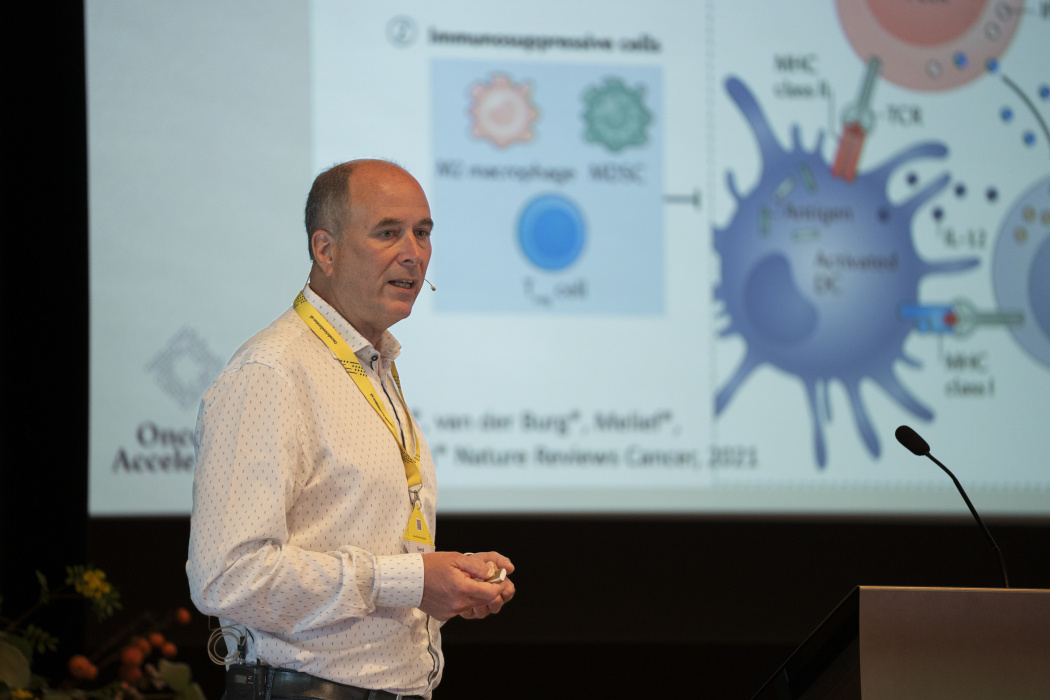
Developing a new type of cancer therapy is no easy task, but there is a strong team behind this Demonstrator Project. The project will be led by Sjoerd van der Burg of Leiden University Medical Center and Oncode Institute in collaboration with Sebastiaan van Heesch (Princess Máxima Center for pediatric oncology and Oncode Institute). Van der Burg is also Lead of the Oncode Accelerator Therapeutic Vaccines Workstream, and van Heesch leads a work package within the Workstream. The Demonstrator Project that launched this week will build on their world-class expertise in identifying and validating TEIPPs with the ultimate aim to develop therapeutic cancer vaccines, and assessing how well those therapeutic vaccines work.
The researchers will work together with the Patient Cohorts Platform of Oncode Accelerator, to obtain valuable patient material for experiments, and with Oncode Accelerator’s Artificial Intelligence (AI) Platform to develop an innovative, AI-driven approach to identify more TEIPPs, faster. The strong involvement of Oncode Institute, sister organization of Oncode Accelerator and exclusive valorization partner for the research groups of Sjoerd van der Burg and Sebastiaan van Heesch, will also contribute to the success of the Demonstrator Project. If successful, TEIPP-based vaccines could offer a new line of defense for patients who currently have few treatment options.
Learn more
Would you like to learn more about Demonstrator Projects and how you can work with Oncode Accelerator? To start discussing how we can collaborate, reach out to demonstrators@oncodeaccelerator.nl.
About Leiden University Medical Center (LUMC)
At LUMC we work together to improve healthcare and people's health. This is what drives us. Every single day. From delivering care to providing care for health. In this process, we join forces to ensure that our initiatives come fully to fruition. As a public institution and innovator, we stand for the improvement of health care. We build towards prevention programs and optimal and innovative care through groundbreaking research and innovative education, together with our partners in the region and beyond. In doing so, we embrace the principles of value-driven care and the use of smart advanced technology. The engine for progress is the daily efforts and great commitment of our employees who work from our core values of personal, connecting, enquiring and curious.
Around 600 children in the Netherlands get cancer every year, and one in four children who are diagnosed with cancer dies from this illness. When a child is seriously ill with cancer, only one thing comes first: cure. That is why at the Princess Máxima Center for pediatric oncology we work together every day in a groundbreaking and passionate way to improve the survival rate and quality of life of children with cancer. Now, and in the longer term. Because children still have a whole life ahead of them. The Princess Máxima Center is not an ordinary hospital, but a research hospital. All children with cancer in the Netherlands are treated here. This makes the Princess Máxima Center the largest pediatric cancer center in Europe. Over 450 researchers and 900 healthcare professionals work closely with Dutch and international hospitals on better treatments and new perspectives on cures. In this way, we give the child of today the very best care and take important steps to improve the chances of survival for the children who are not yet cured.
About Oncode Institute
Oncode Institute is a research institute dedicated to realizing breakthroughs in the understanding of cancer and translating them into clinical practice for the benefit of cancer patients. The institute is founded on three pillars: Excellent Science, Collaboration, and Valorization – together creating impact. The institute unites over 750 researchers at 13 partnered research institutes across the Netherlands, all dedicated to achieving the same mission: to drive breakthrough discoveries and accelerate their translation into new diagnostics and treatments for cancer patients. Even in its short existence, the institute has driven the identification of treatment improvements and discovery of new therapies, and has established 10 start-ups— all with the goal of improving the survival and quality of life of cancer patients.