

News
How Childhood Liver Tumor Cells Acquire Different Features
How cells communicate and develop is controlled by communication pathways. The so called Wnt signaling pathway plays a central role in almost all childhood liver tumors. Researchers from the Princess Máxima Center and Linköping University in Sweden - supported by Oncode Accelerator, Stichting Kinderen Kankervrij (KiKa) and the Princess Máxima Center Foundation (Kus van Kiki) - have now discovered how this pathway can result in tumor cells with different features within a single tumor. Their findings contribute to better classification of these tumors and, in the future, more tailored treatments.
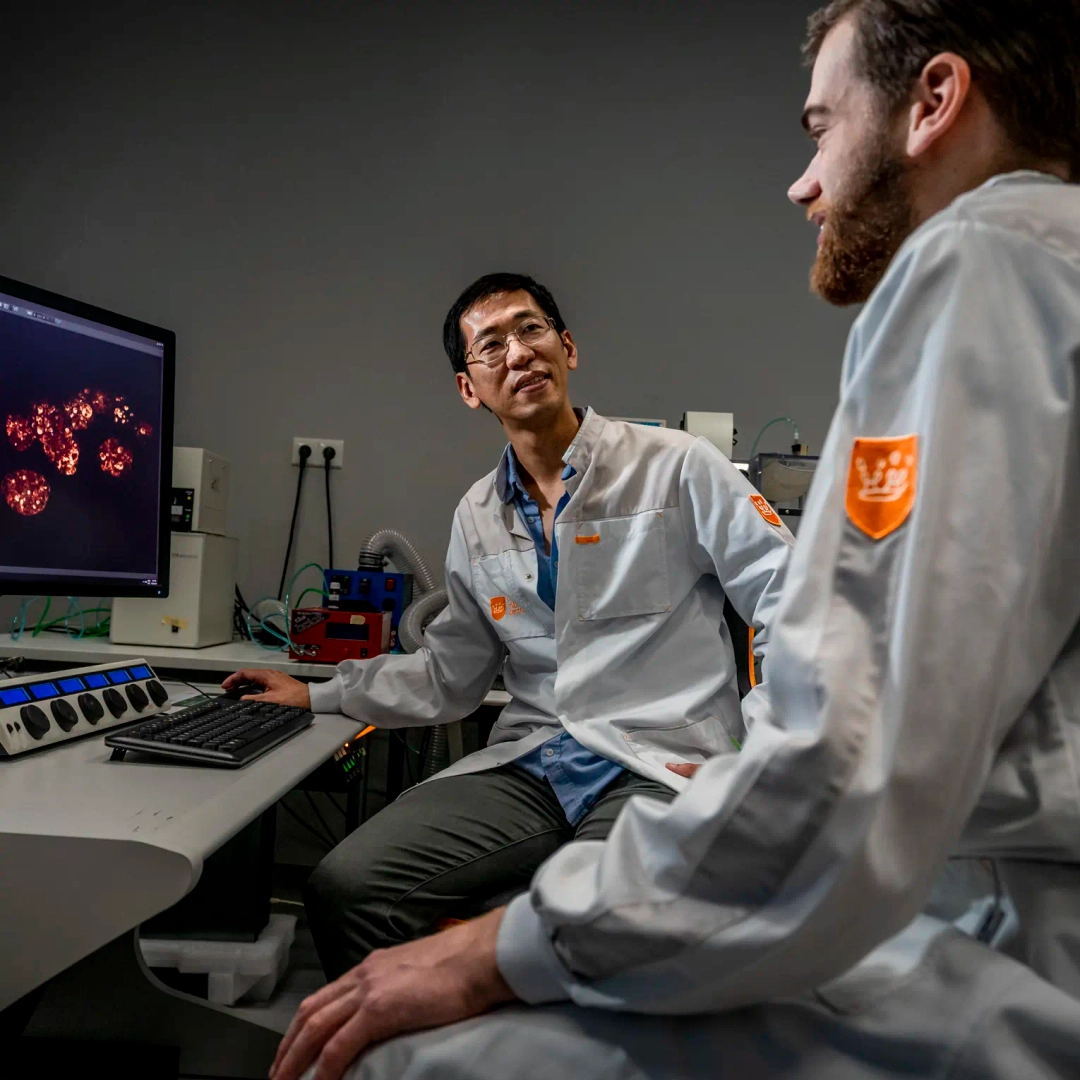
Hepatoblastoma is the most common form of liver cancer in children. In the Netherlands, around ten to fifteen children are diagnosed with the disease each year. Nearly all hepatoblastomas carry a change in the same gene, CTNNB1. This is the key activator of the Wnt signaling pathway.
Biological explanation
Yet despite sharing common genetic driver CTNNB1, these tumors often contain two main cell types: the fetal type, that is more differentiated and the less differentiated embryonal type. Researchers expect that the way the tumor is composed of these two cell types influences the effectiveness of chemotherapy treatment. Classification based on tumor composition could thus play an important role to provide children with liver cancer with more tailored treatments.
Previously, researchers from the Peng group at the Princess Máxima Center for pediatric oncology identified how to distinguish between the two types making classification possible. These biomarkers are now used by the Children’s Oncology Laboratory at the Princess Máxima Center, while their broader clinical value continues to be evaluated. Research group leader Dr. Weng Chuan Peng elaborates: "This study provides a biological explanation for why the biomarkers we previously identified are so effective at distinguishing these tumor cell types."
Biological programs
Using lab grown patient-derived mini liver tumors and advanced genomic technologies, the researchers uncovered how activation of the Wnt pathway causes these two distinct tumor features. Thomas Kluiver, PhD student in the Peng group at the Princess Máxima Center, worked closely with Anna Nordin from the laboratory of Professor Claudio Cantù at Linköping University. Thomas explains, "We found that the same change in DNA can lead to different cell types, depending on which biological programs are active in a cell. It is not just the mutation itself, but also the ‘molecular partners’ in the pathway that determine how that mutation is interpreted."
Understanding tumor diversity
Because Wnt signaling plays an important role in many types of cancer in both children and adults, these findings may also be relevant for other researchers. Weng Chuan adds, "While our work focuses on a rare childhood liver cancer, the underlying principle is likely much broader. Learning how cells interpret the same genetic mutation in different ways may help us better understand tumor diversity across many forms of cancer and ultimately guide the development of more precise therapies."
How Wnt signaling drives different tumor cell types
Activating mutations in the CTNNB1 gene are the driver oncogenic alteration of nearly all hepatoblastomas. The CTNNB1 gene encodes the β-catenin protein, a key activator of the Wnt signaling pathway that control how cells grow, develop, and function.
The mutations alone do not explain why individual tumors contain distinct fetal-like and embryonal cell populations. To address this question, researchers combined patient-derived hepatoblastoma organoids with single-cell transcriptomics, chromatin accessibility profiling, and CUT&RUN analyses. The CUT&RUN experiments were performed in collaboration with the laboratory of Professor Claudio Cantù at Linköping University. Using these lab-grown patient-derived mini liver tumors and advanced genomic technologies, the researchers uncovered how activation of the Wnt pathway gives rise to two distinct tumor cell populations. The study was published recently in PNAS.
Transcription factor determines signaling outcome
The researchers investigated two cellular programs corresponding to the fetal-like and embryonal tumor cell populations characteristic of hepatoblastoma. Although both are driven by constitutive β-catenin activation, the downstream transcriptional program depends on the transcription factor partner with which β-catenin interacts.
In fetal-like tumor cells, β-catenin primarily cooperates with TCF7L2 to activate liver differentiation programs. In embryonal tumor cells, it preferentially partners with LEF1, redirecting β-catenin toward developmental gene networks associated with a less differentiated cellular state. This provides a molecular explanation for how the same oncogenic pathway can generate distinct tumor cell populations within a single tumor.
Professor Claudio Cantù, internationally recognized expert in Wnt signaling and developmental biology from Linköping University, comments, "Our work shows that the outcome of Wnt signaling depends on the transcription factor partners with which β-catenin interacts. Because similar regulatory networks operate in many tissues, this mechanism may also help explain how Wnt signaling produces different outcomes in other cancers."
Original source of article: https://www.prinsesmaximacentrum.nl/en/news/how-childhood-liver-tumor-cells-acquire-different-features
About the Princess Máxima Center for pediatric oncology
Around 600 children in the Netherlands get cancer every year, and one in four children who are diagnosed with cancer dies from this illness. When a child is seriously ill with cancer, only one thing comes first: cure. That is why the Princess Máxima Center for pediatric oncology works together every day in a groundbreaking and passionate way to improve the survival rate and quality of life of children with cancer. Now, and in the longer term. Because children still have a whole life ahead of them. The Princess Máxima Center is not an ordinary hospital, but a research hospital. All children with cancer in the Netherlands are treated here. This makes the Princess Máxima Center the largest pediatric cancer center in Europe. Over 450 researchers and 900 healthcare professionals work closely with Dutch and international hospitals on better treatments and new perspectives on cures. In this way, the Princess Máxima Center gives the child of today the very best care and take important steps to improve the chances of survival for the children who are not yet cured.
Website: https://www.prinsesmaximacentrum.nl/en
About Stichting Kinderen Kankervrij (KiKa)
KiKa is the only charity in the Netherlands that invests in research specifically focused on all forms of childhood cancer. KiKa raises funds for innovative research and other activities in the field of childhood cancer, aimed at less pain, more cure and a better quality of life. Furthermore, KiKa focuses on education on childhood cancer.
Website: https://kika.nl