

News
TNO: Innovation In Action
As a partner of Oncode Accelerator, TNO brings world-class translational technology and AI-driven insights to the oncology ecosystem. We spoke with Principal Scientist Wouter Vaes and Senior Scientist Jennifer McCormack-Venhorst to explore how TNO’s unique mix of tech and knowledge can enable safer, faster and more predictive cancer drug development so that better therapies reach patients sooner.
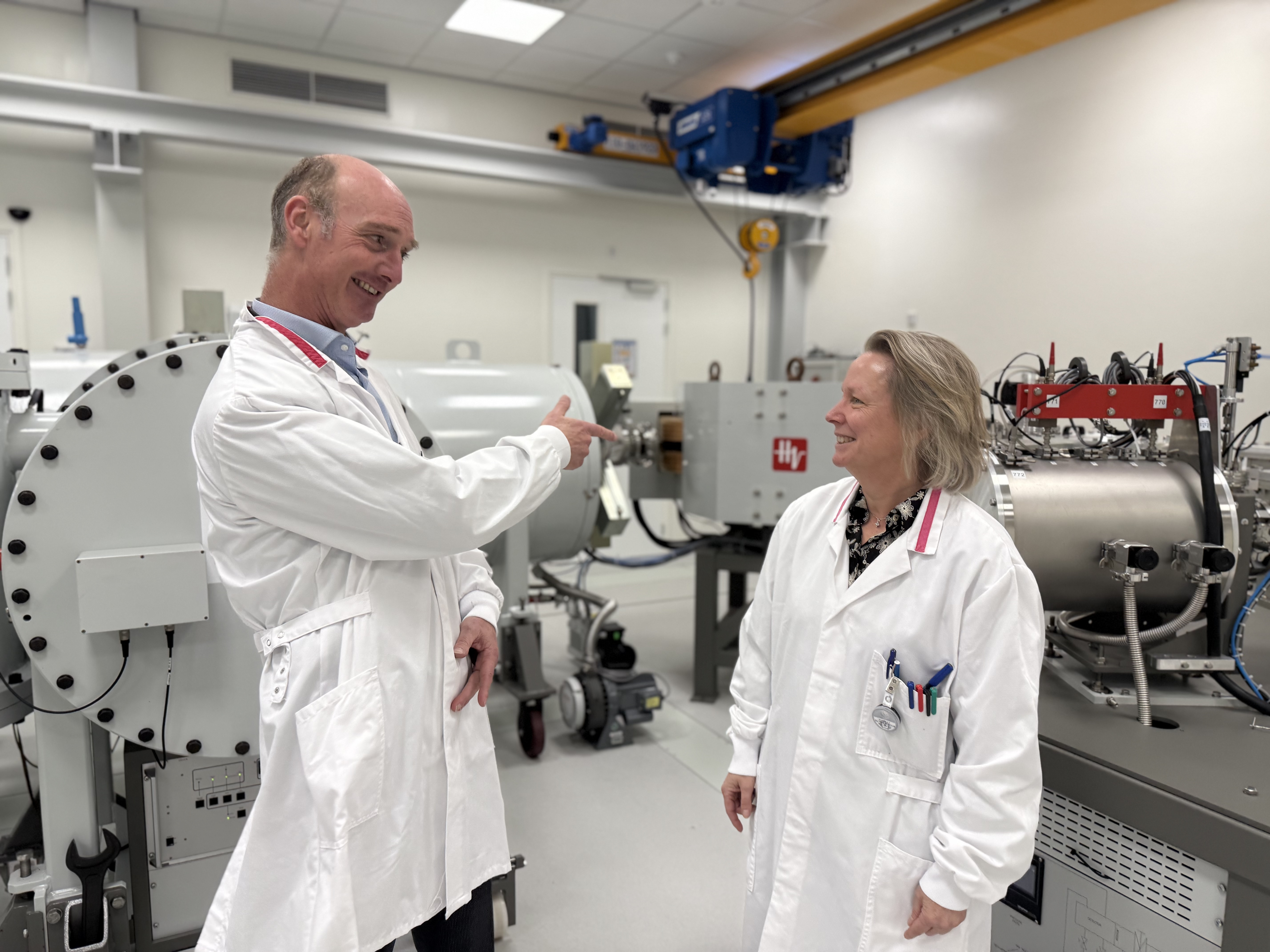
TNO is an innovation organization that faces tough societal challenges like cancer drug development head-on. In the words of Principal Scientist Wouter Vaes: “We aim to bring new concepts to life that have impact and significance for companies, for society, or both.” Rather than focusing on a single domain, TNO typically develops and validates technologies that can be broadly used. As a partner of Oncode Accelerator, TNO’s broad expertise is applied to Demonstrator Projects: oncology drug discovery and development projects that receive co-funding from Oncode Accelerator. Senior Scientist Jennifer McCormack-Venhorst adds, “We connect technology with knowledge and work in collaboration with others, to have impact for science and society.”
Unique Facilities in Action
Accelerator Mass Spectrometry (AMS) is one of the cutting-edge technologies that TNO offers. Wouter Vaes explains its use in drug development: “AMS is an incredibly sensitive way to measure carbon-14, a radioactive isotype. Typically, carbon-14 is not used in drugs – but you can incorporate it if you need to. The sensitivity of AMS allows us to dose human subjects with very low amounts of radioactivity and thereby trace back everything related to the drug metabolism, so-called microtracer studies. For instance, we can assess the safety of the drug by identifying its metabolites, how these are excreted, and potential drug-drug interactions.”
Because radioactivity levels are very low but still traceable, AMS technology also makes microdosing studies possible. “The dose makes the poison,” says Wouter, quoting Paracelsus, the Swiss physician credited as the father of toxicology. “If you lower the dose to extremely low levels you can give anybody otherwise toxic molecules in a harmless fashion. Because AMS is so sensitive, we can lower radioactivity doses by factors of a hundred to one thousand times – making radioactivity studies that otherwise would not be ethically permissible. Microdosing and microtracer studies are reshaping the clinical development pipeline and are truly a paradigm shift. And as of last year, they have been adopted for FDA guidance.”
Using AMS, these so-called “phase 0” microdosing studies can be run, to assess the pharmacokinetics and metabolism of novel drugs. This cutting-edge technology is already used to assess small molecule therapies – and the scientists at TNO and Oncode Accelerator are collaborating to build it even further.
“Currently, because of the difficulty with prepping samples for AMS, we only analyze a limited number of samples per study participant for metabolic profiling: one plasma, one urine, and one feces sample,” says Wouter. “We can get a lot of information out of these samples, but it would be better to make sample analysis faster, to be able to collect even more data. In collaboration with the Small Molecules Workstream of Oncode Accelerator, we are developing new technology that will enable us to increase the data density of these studies.”
Big Plans for Biologics
As well as applying this technology to assess the pharmacokinetics of small molecule-based cancer therapies, TNO and Oncode Accelerator are also teaming up to apply AMS to antibody-based therapeutics.
In the ideal world, when studying antibody-based therapeutics in humans or animals, it would be possible to dose many different antibodies at the same time in a single subject. This would help to distinguish the efficacy of different antibodies against the high background noise of inter-subject variation. Wouter recalls, “I got the question from a collaborator: isn’t there a way to dose ten antibodies at the same time and tell us which one has the highest tumor penetration rate? At the time there wasn’t. Now, our moonshot is to advance AMS technology so that we can run studies in which patients are microdosed with five to ten antibodies pre-operatively. Then, post-operatively, we can analyze the tumor and see which antibody had the best penetration.”
In collaboration with the Oncode Accelerator Biologics Workstream, Wouter is now setting up the first proof of principle studies in animals. “The biologics experts at UMC Utrecht design and select antibodies, we label the antibodies with carbon-14, and then our collaborators at the Netherlands Cancer Institute have suitable animal tumor models to dose labeled antibodies. Back here at TNO, we receive the tumors and will see if it’s possible to distinguish which biologics have good or bad tumor penetration using AMS.”
After validation of the methodology in animals, the next stage will be to go to humans. “There are many barriers to moving to humans – but the beauty of this approach is that microdosing is inherently safe,” says Wouter.

Wouter Vaes, Principal Scientist, TNOThere are many barriers to moving to humans – but the beauty of this approach is that microdosing is inherently safe.
Knowledge Meets Technology
As well as developing physical technology, the experts at TNO are also at work in silico. For example, Jennifer McCormack-Venhorst and her colleagues have built an AI-enabled platform that allows drug developers to understand the relationships between proteins or compounds and health effects. “This gives us an opportunity to extrapolate information that is not necessarily visible in the literature,” she explains.
TNO also uses AI-driven algorithms to perform drug target safety assessments, which traditionally are done manually. “With a target safety assessment, the question is: based mainly on literature, which toxicological effects can occur when a drug inhibits or activates the target? Reviewing all those publications requires substantial time and effort and is subject to human bias. Additionally, the growing availability of data increases the chance of missing crucial information,” says Jennifer. “We are trying to overcome this through automation, by asking a generative AI model to extract the relevant information out of papers and other textual documents, make safety claims, and assess what the highest risks are based on the available evidence.”
Especially when applying it to toxicology, the trustworthiness of AI is a challenge – but it can be managed. Jennifer explains: “We have several ways to ensure we have sufficient confidence in the answers we get, for instance by including domain knowledge into our models via a formalized structure called an ontology, having other LLMs act as ‘judges’ to back-check the information generated, and ensuring that the answer provided is falsifiable via human-in-the-loop.”
Overall, Jennifer is convinced that intelligently applying AI can accelerate the development of cancer therapies, without making human expertise obsolete. “I think in the future, we’ll be able to let AI do the routine tasks, so humans can do the more exciting work.”
Opportunities for Demonstrator Project Partners
Target safety assessments are a key offering of TNO within the Oncode Accelerator ecosystem, which can help drug developers executing Demonstrator Projects de-risk their work. This is offered through the Oncode Accelerator Small Molecules Workstream. Jennifer elaborates: “Toxicology is performed routinely by big pharma, but if you look at start-ups or newer, smaller companies, activities like target safety assessments are not always done. I think that’s a missed opportunity. It’s a shame if you progress far into a drug development pipeline and then perform toxicology studies too late and get negative results. That’s why we are trying to educate people, to make people aware that target safety assessments are something that can and should be done early – even before you start synthesizing and screening compounds. It can save a lot of time and effort.”

Jennifer McCormack-Venhorst, Senior Scientist, TNOToxicology is performed routinely by big pharma, but if you look at start-ups or newer, smaller companies, activities like target safety assessments are not always done. I think that’s a missed opportunity. It’s a shame if you progress far into a drug development pipeline and then perform toxicology studies too late and get negative results.
Wouter adds: “There is also a lot of benefit in adopting human-translatable approaches earlier in drug development. In the end, models are just models, and animal models are often not consistent, giving very different pharmacokinetic data. Performing microdosing studies can be crucially important in making the right choices early on, to avoid going into a phase 1 clinical study with the wrong candidate. For me, setting up a small-scale microdosing study is a no-brainer.”
“TNO can also support drug developers in the mechanistic aspects of drug development – understanding processes of a disease,” Jennifer adds. “Microdosing can also have a role there, in helping scientists to understand why a certain therapeutic strategy will or will not work,” Wouter elaborates: “We are also starting to set up microdosing studies to identify new biomarkers that can tell us if certain metabolic pathways are influenced. We want to be able to see if a target pathway is being hit, even in healthy volunteers treated. People typically think that if there is no disease, you won’t be able to see if a target is being hit, but with new technologies like pathway probe microdosing this becomes possible.”
Innovating, Together
From Wouter and Jennifer’s perspective, a key reason to partner with Oncode Accelerator is to share their expertise, provide access to the innovative technologies at TNO, and thereby drive forward progress in oncology. “The technologies we are developing can have a big impact in oncology. But as well as tech, you need the right people around you to make progress happen. And Oncode Accelerator brings a lot of partners together,” says Wouter.
Wouter Vaes, Principal Scientist, TNOThe technologies we are developing can have a big impact in oncology. But as well as tech, you need the right people around you to make progress happen. And Oncode Accelerator brings a lot of partners together.
Jennifer adds, “By working together and sharing our expertise, we can de-risk and speed up the whole drug development process, stop projects that won’t be successful early-on, save money and time, and make sure that good drugs are on the market sooner to benefit patients.”
Wouter concludes: “Currently, 97 percent of oncology drugs fail in clinical trials. That’s disastrous. We can do better.”
About TNO
TNO is the innovation engine of the Netherlands. TNO is an independent, not-for-profit research organization that supports the Dutch government in carrying out statutory and other government tasks in the public interest and helps to boost the earning power of the Netherlands. Driven to push boundaries, TNO creates impactful innovations for the sustainable wellbeing and prosperity of society by working together with (inter)national companies and organizations as well as the government.