

News
UPyTher’s Demonstrator Project: From Fundamental Science to a New Platform for Cancer Therapy
Peritoneal metastases are notoriously difficult to treat. They arise when cancer cells spread into the abdominal cavity, forming many small tumors. For patients with peritoneal metastases, treatment options are scarce, outcomes are often poor, and many are left with little more than palliative care. Can we do better for these patients? The team at UPyTher, a start-up company out of TU Eindhoven that recently kicked off a collaboration with Oncode Accelerator, is convinced that we can.
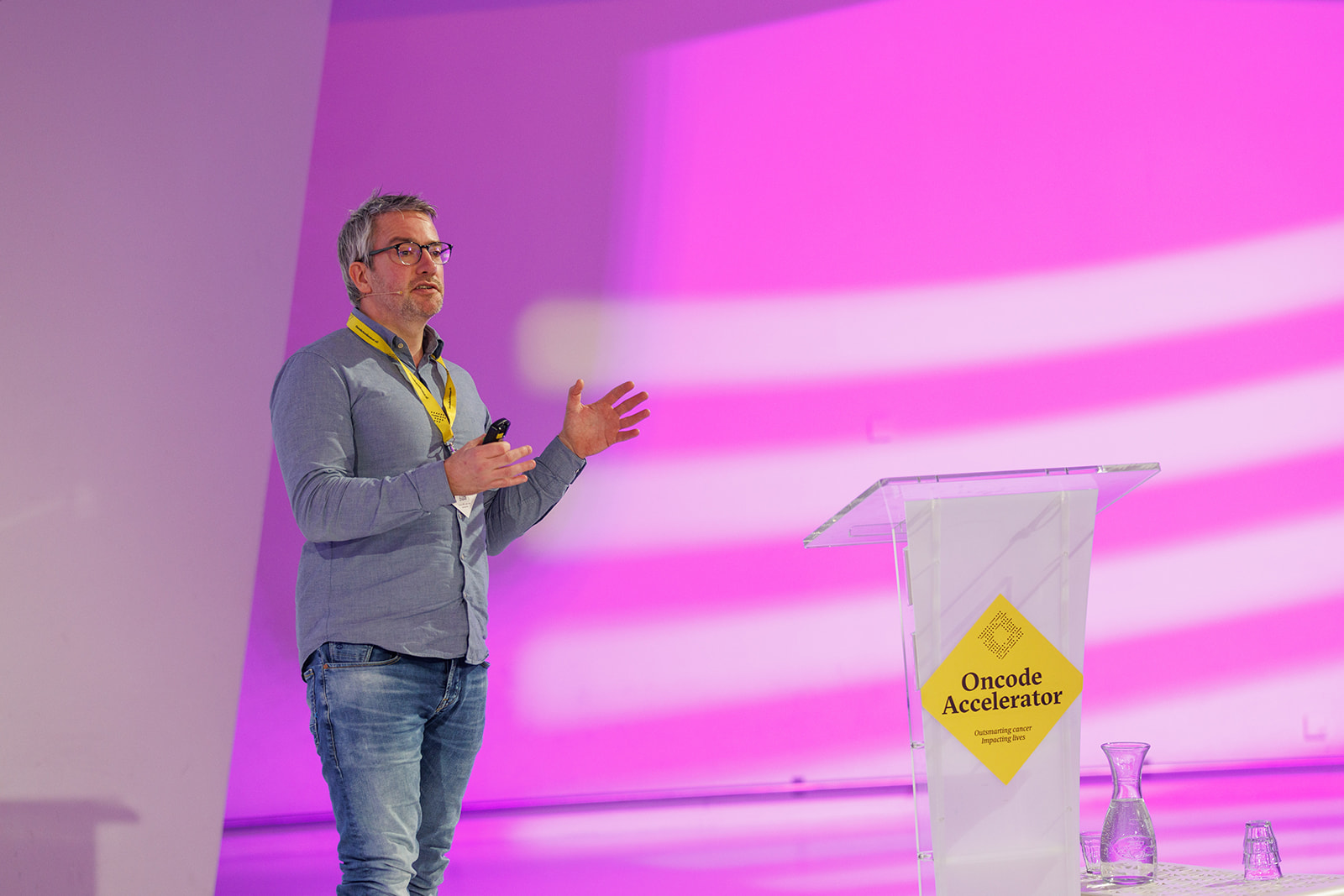
Biomaterials meet Cancer Biology
Peter-Paul Fransen, co-founder and CTO of UPyTher, has a background in biomedical engineering, with a focus on biomaterials and a PhD in chemistry. After his post-doctoral work in the biomaterials research group of Professor Patricia Dankers, he jumped into the start-up company UPyTher.
With his fundamental research background in biomaterials, Peter-Paul’s jump to oncology drug development was not an obvious one. “We know the fundamentals of biomaterials and hydrogels, and we want to use that knowledge to help others,” he explains. “The jump to focusing on cancer was a technology pull. It started when a surgical oncologist, Ignace de Hingh, visited the DankersLab with a drug delivery challenge. Together with Geert van Almen, CEO of UPyTher, and Patricia Dankers we realized that our technology was a great match for this clinical need.”
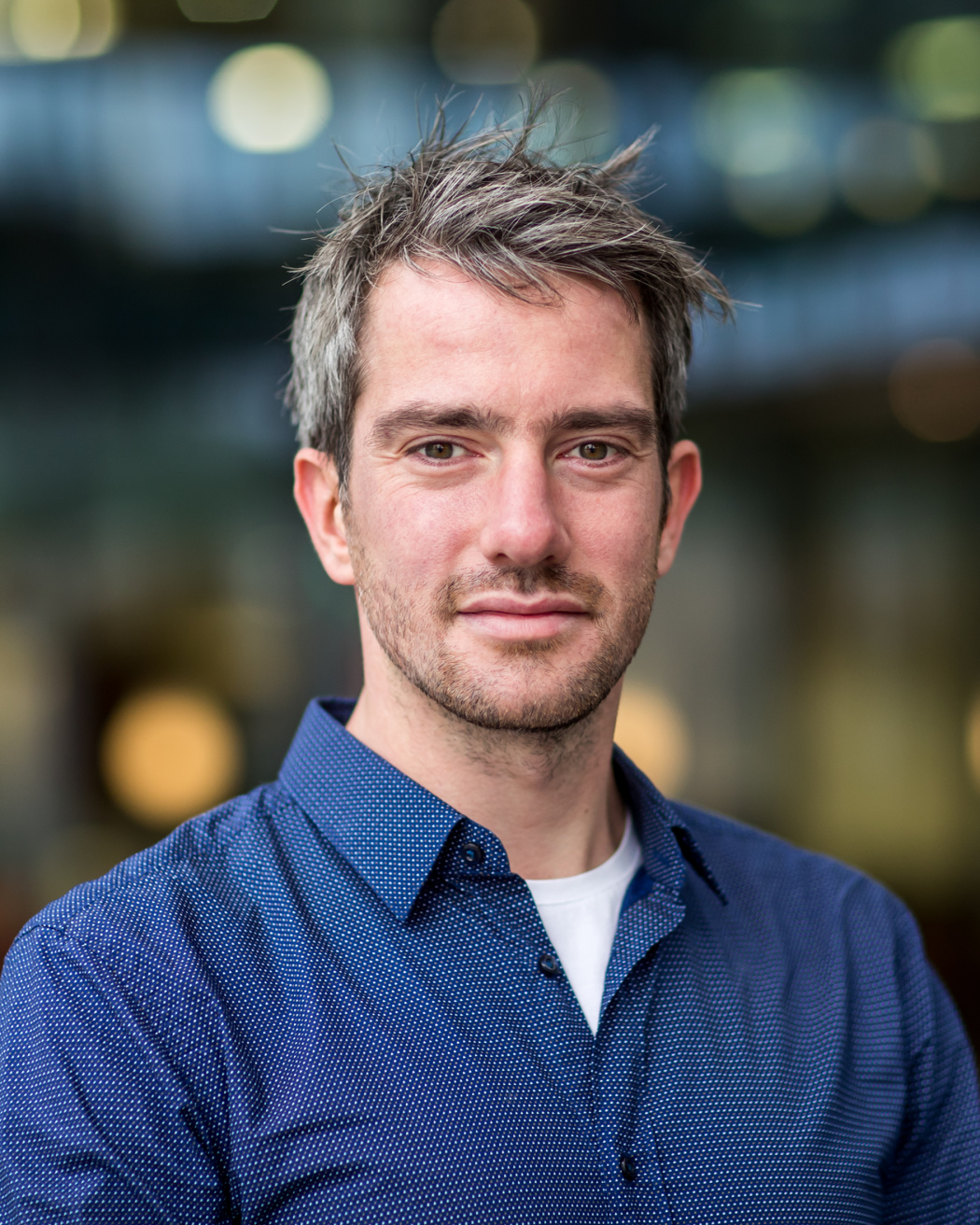
These cross-domain conversations led Peter-Paul to appreciate the gap in care for patients with peritoneal metastases: “Because peritoneal metastases are characterized by many small tumors in the abdominal cavity, it can be very hard to destroy all the spread-out cancer cells. These patients have very few treatment options, and there are very few products dedicated specifically to treating peritoneal metastases.”
Part of the problem is that many of the anti-cancer drugs available on the market are developed for systemic, intravenous use – but drugs delivered through the bloodstream often fail to reach the peritoneal cavity in sufficient concentrations. Surgery is an alternative option. However, only about a minority of patients with peritoneal metastases are eligible for surgery, while the rest typically receive palliative treatment.
Peter-Paul explains: “The surgical procedure involves opening the abdominal cavity, removing all visible tumors, and then performing a HIPEC procedure – flooding the whole abdominal cavity with chemotherapy for 60 to 90 minutes. The problem is that patients have to be relatively fit to be eligible for this surgery, and we also see that the treatment time is too short. But if we can prolong that chemotherapy exposure time, we see better effectiveness and we miss fewer tumor cells.”
Peter-Paul Fransen, co-founder and CTO of UPyTherBy focusing in on patients with peritoneal metastases, we can develop more specific therapies that could deliver better outcomes.
That’s where UPyTher comes in. Their mission is to set a new standard of care in peritoneal oncology — to make treatment for these patients safer, simpler, and more effective through the use of their powerful platform technology. “By focusing in on this group of patients, we can develop more specific therapies that could deliver better outcomes.”
Reaching Peritoneal Metastases Everywhere They Hide
UPyTher’s answer to this gap in cancer care is grounded in their expertise in biomaterials – and in particular their experience with so-called ‘UPy’ (ureido-pyrimidinone) polymers. UPys are a special class of proprietary polymers originally designed and developed at TU/e Eindhoven. UPyTher uses them as the basis for their injectable hydrogel technology.
“UPys give very special, unique qualities to polymers,” explains Peter-Paul. “UPys make polymers easier to process, and in the case of hydrogels can help make them injectable and give them very dynamic mechanical properties to suit challenging, complex environments such as the abdominal cavity. The abdominal cavity is challenging because it’s very big, and it is dynamic because the organs in your abdomen are moving all the time, for instance as you digest food. We needed to work with a very innovative material to match this environment.”
How does this work? “You can think of UPys like Lego blocks that can stack,” he elaborates. “At a low or neutral pH, they are very good at stacking like Lego – the individual UPy ‘blocks’ can crosslink and build a hydrogel. But at a higher pH, they don’t stack together, the UPys don’t form crosslinks, and the biomaterial stays liquid – lots of separate Lego blogs instead of a bigger Lego creation. This means that we can inject the hydrogel in liquid form, at an elevated pH, and then once the hydrogel is in the body it spreads as a thin film rather than forming a single bulky depot. Then, because the pH is lower in the body, it solidifies into a gel.”
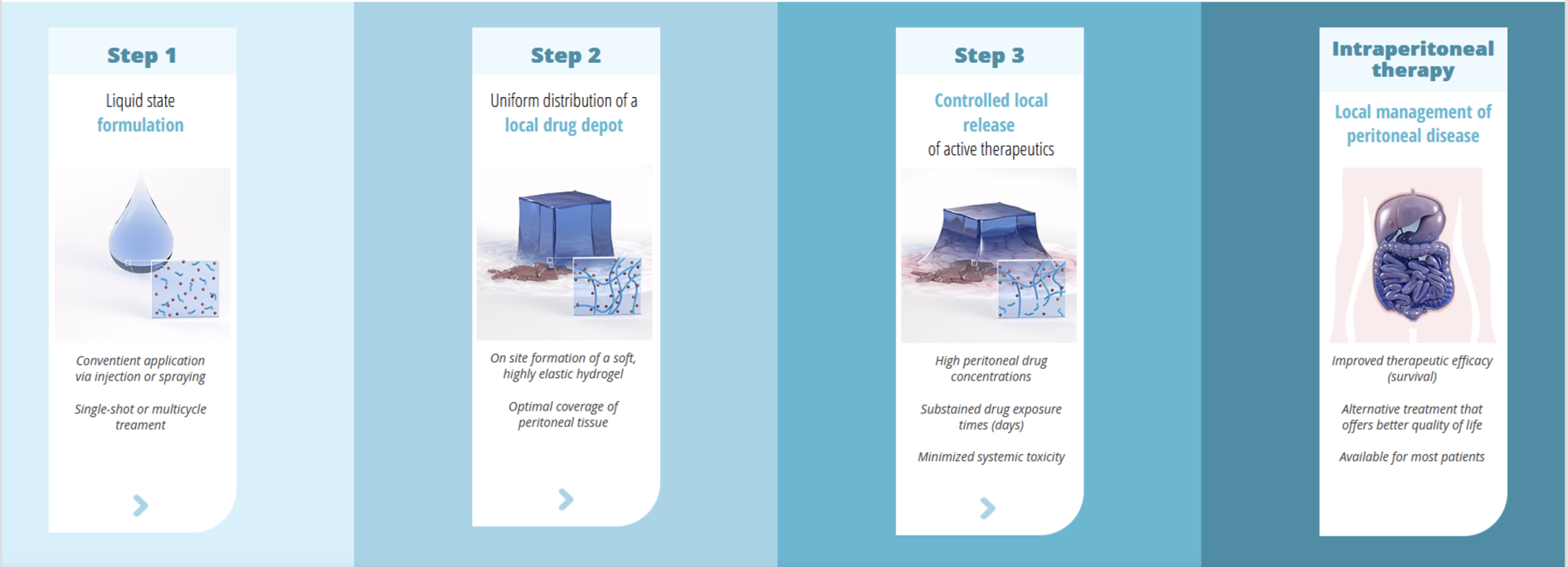
Drugs added to the liquid hydrogel can thereby be administered during surgery, via catheter, or even by spraying. After administration, the gel spreads evenly over the targeted tissue to enable prolonged, local drug release. Altogether, this can make the treatment safer and more effective. “In the abdominal cavity, peritoneal metastases can be everywhere,” Peter-Paul explains. “So, the therapy should also be everywhere, and work for a longer period of time.”
Peter-Paul Fransen, co-founder and CTO of UPyTherIn the abdominal cavity, peritoneal metastases can be everywhere. So, the therapy should also be everywhere, and work for a longer period of time.
Serving Diverse Patients
Peter-Paul envisions that the flexibility of UPyTher’s platform approach will allow them to serve three distinct patient groups:
- Patients with peritoneal metastases that are eligible for surgery: For the limited group of patients that is eligible for surgery, the UPy hydrogel can be used to evenly spread anti-cancer drugs over the abdominal cavity and prolong drug exposure.
- Patients with peritoneal metastases that are not eligible for surgery: For the majority of patients that cannot undergo surgery, administering the injectable UPy hydrogel via a catheter could prolong survival, reduce disease burden, and in some cases make them eligible for surgery later on.
- Patients with primary cancer who are at risk for metastasis: In high-risk patients, the hydrogel could be applied in the abdominal cavity after surgery to remove a primary tumor. This could destroy cancer cells missed during surgery and prevent them from forming peritoneal metastases.
To move closer to clinical reality, UPyTher is already rigorously testing its technology. They have performed tests in mini pigs, a model with an abdominal cavity comparable to that of humans, to optimize factors like safety, volumes, and release profiles. As of December 2025, UPyTher will collaborate with Oncode Accelerator to further test and optimize their approach.
Collaboration at the Heart of Innovation
Treating peritoneal metastases requires more than advanced materials science. It also demands deep understanding of tumor biology, drug mechanisms, and clinical realities. This is where UPyTher’s collaboration Oncode Accelerator plays a crucial role.
Within a new Oncode Accelerator Demonstrator Project, UPyTher will collaborate with Professor Onno Kranenburg (UMC Utrecht), member of the Oncode Accelerator Organoids Platform, alongside Professor Boudewijn Burgering (UMC Utrecht) of the Oncode Accelerator Small Molecules Workstream to rationally design combination therapies for the treatment of peritoneal metastases.
The interdisciplinary team will start by testing combination therapies of a standard chemotherapeutic alongside DNA damage response (DDR) inhibitors that could be delivered via UPyTher’s hydrogel platform. “By combining an existing chemotherapy with DDR inhibitors and delivering them using our hydrogel, we expect that we can induce more damage to the tumor cells. We will first test the synergy of the chemotherapy and DDR inhibitors in vitro in organoids – lab grown mini-organs/tumors. The best candidates will be formulated into our hydrogel,” says Peter-Paul. “Then, we can test the hydrogel formulations in a unique model from Onno Kranenburg’s lab. He has developed mouse models with transplanted organoids from real human cancer patients. This model closely mimics peritoneal metastases in humans.”
Through the collaboration with Prof. Burgering, the UPyTher team will also apply a proteomics-driven approach to study on- and off-target effects of the combination therapies, gain data on their mechanisms of action, and ultimately create a compelling data package. “This is important both for eventual submission to regulatory authorities as well as for future industry partnerships. Performing these collaborative studies within our Demonstrator Project is important for our science, for patients, and for our company,” Peter-Paul states.
A Shared Mission to Outsmart Cancer
UPyTher’s mission strongly aligns with that of Oncode Accelerator: to collaboratively optimize and accelerate the development of new cancer therapies for the benefit of patients of all ages. By focusing on a patient population with few alternatives, the start-up company exemplifies how smart innovation and cross-domain collaboration can translate fundamental science into real-world impact.
“For us, there are several benefits to working with Oncode Accelerator,” Peter-Paul reflects. “We gain access to oncology expertise and advanced models, co-funding to help bring our tech towards the clinic, and visibility within the broader scientific and clinical community.” The Demonstrator Project will help UPyTher build a foundation for future investment, alongside future collaborations. “For this Demonstrator project we are focusing on small molecules, but there are also other options in oncology. We already know that combining various drug modalities, including antibodies and antibody-drug conjugates, in our hydrogel is technically feasible. We could investigate these in future collaborations through Oncode Accelerator.”
Peter-Paul Fransen, co-founder and CTO of UPyTherWe want to give patients with peritoneal metastases a real chance — with therapies designed specifically for them, not adapted as an afterthought.
The UPyTher hydrogel platform’s flexibility makes it attractive to partners developing new therapeutic modalities, since compounds can be quickly formulated, tested for safety and release, and evaluated in relevant models. Peter-Paul elaborates: “We’re looking for partners that have models related to gastrointestinal or gynecological cancers, or who have new therapeutic modalities that could be administrated through our hydrogel platform. We are also looking for additional funding to get this technology into the clinic. We want to push the boundaries of polymer technology and medicine administration to enhance therapeutic outcomes!”
“Our goal is simple but ambitious,” concludes Peter-Paul. “We want to give patients with peritoneal metastases a real chance — with therapies designed specifically for them, not adapted as an afterthought.”
By bringing together biomaterials science, tumor biology, and collaborative drug development, UPyTher and Oncode Accelerator are collaborating to reach cancer everywhere it hides — and to change outcomes for patients who need it most.
About UPyTher
UPyTher B.V. is a private pharmaceutical company based in Eindhoven, the Netherlands that is dedicated to turn peritoneal cancer into a treatable disease. Building upon proprietary polymer technology, UPyTher pioneers innovative therapeutics that are specifically designed and developed for use in the peritoneal cavity. UPyTher aims to establish a new standard in intraperitoneal therapy that offers lifesaving opportunities for patients and makes intraperitoneal therapy simple, safe and effective.
Photo credit: Seth Carnill