

News
Patient cohorts as a catalyst for new cancer treatments
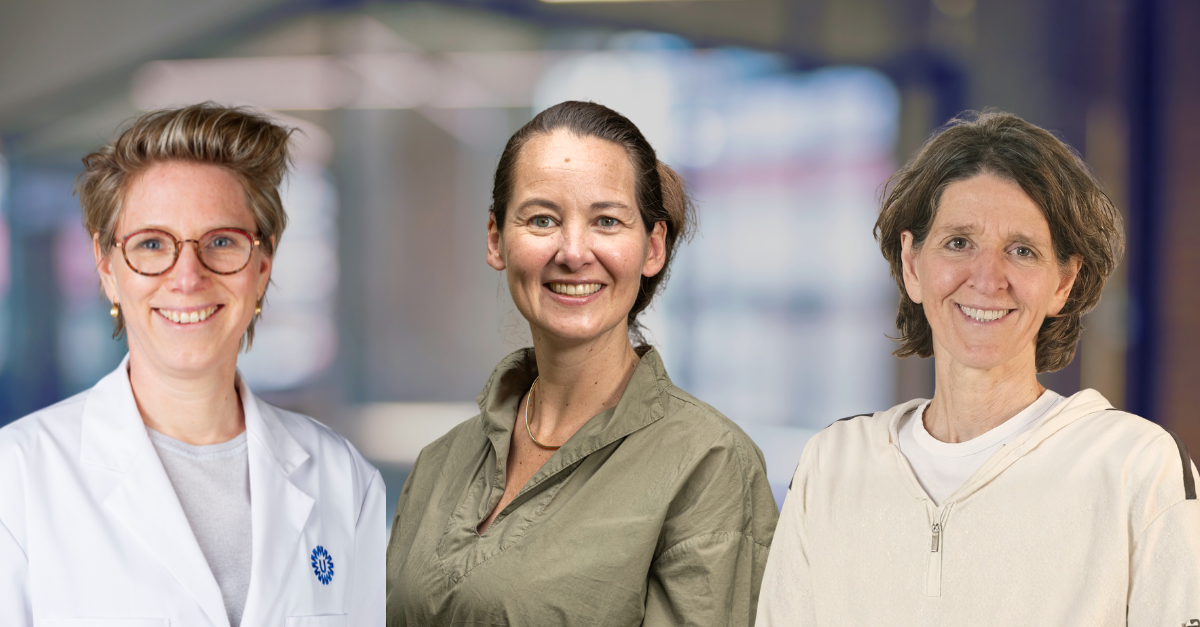
Three medical oncologists share their perspectives on the role of patient cohorts within Oncode Accelerator Demonstrator Projects. Prof. Jeanine Roodhart and Prof. Miriam Koopman (both UMC Utrecht) and Prof. Agnes Jager (Erasmus MC Cancer Institute, Rotterdam) discuss what has been built over the past few years and how patient cohorts can help better align preclinical drug development with the needs of patients.
Patient Cohorts as a Foundation for Drug Development
Over the past few years, the Patient Cohorts Platform has worked extensively to establish and further develop ten national patient cohorts. At the same time, important steps have been taken to collect and make real-world data accessible, to make biomaterials and genomic information available, and to establish connections with the early-phase clinical trials platform.
“We have taken important steps in further developing the patient cohorts over the past few years,” says Jeanine Roodhart, lead of Oncode Accelerator’s Patient Cohorts innovation Platform. “We have further developed and connected the cohorts and are working to make clinical data, tissue and blood increasingly available for preclinical drug development. Together with the Netherlands Comprehensive Cancer Organisation (IKNL), we are also taking steps towards real-time data collection, increasingly enabling data to be extracted automatically from medical records. To achieve this, and increase uniformity, we are setting standards for minimally required datasets.”
Patient cohorts – well-defined groups of patients with specific cancer types – make it possible to bring together knowledge, data and biomaterials from different patient populations. This creates an infrastructure that not only connects different research groups more effectively, but also offers new opportunities to identify and select patients more precisely for research and clinical trials.
“Supporting and bringing the cohorts together enables the research groups involved in the cohorts to learn from one another, and to make the most of each cohort,” says Roodhart. “This integration also allows us to link clinical data, tissue and blood so that they can be used for preclinical drug development. By registering high-quality data in real time, we can also send targeted questionnaires to patients and approach them for a suitable trial. In this way, we are developing a system in which we can learn from all patients and make new treatment options available to them more quickly.”
Dr. Jeanine Roodhart, Professor at UMC Utrecht and Lead of the Oncode Accelerator Patient Cohorts PlatformSupporting and bringing the cohorts together enables the research groups involved in the cohorts to learn from one another, and to make the most of each cohort. This integration also allows us to link clinical data, tissue and blood so that they can be used for preclinical drug development.
Targeted Collaboration
Bringing together existing knowledge, infrastructure and expertise is an important part of Oncode Accelerator’s approach. Within the program, public and private partners work together to better connect the different elements of the development process. Funding from the Dutch National Growth Fund played a crucial role in making this possible as quickly as possible.
“It is fantastic to see how quickly we have managed to professionalize into a closely collaborating group,” says Miriam Koopman, one of Oncode Accelerator’s initiators. “We now have a clear overview of the knowledge and collaborations that already exist and of what we can learn from one another.”
Dr. Miriam Koopman, Professor at UMC UtrechtIt is fantastic to see how quickly we have managed to professionalize into a closely collaborating group. We now have a clear overview of the knowledge and collaborations that already exist and of what we can learn from one another.
This also fulfilled a long-standing ambition, says Agnes Jager. “There had been previous initiatives to achieve the goals that Oncode Accelerator is now pursuing, but they always proved difficult to put into practice. Now everything is coming together, and all the traffic lights are green or at least orange. There is still a lot to do – making sure that different parts of the program connect to each other efficiently, for example – but there are no red lights left. We would never have been able to achieve this individually. And we will soon start seeing the impact at patient level: we will be able to select patients who are eligible for a study more efficiently. And in this way, we will bring new innovative medicines to patients faster, which is of course fantastic.”
From Patient Cohorts to Demonstrator Projects
With the foundation now laid, there is now room for the next phase. “Many laboratory discoveries do not make their way to patients, and when they do, it takes too long,” says Roodhart. “To improve and accelerate this process, we use patient cohorts for Demonstrator Projects, in which new cancer therapies are developed and tested in collaboration with companies and researchers. This allows us to conduct preclinical studies more quickly, based on real-world evidence from the patient cohorts.”
Oncode Accelerator currently supports ten patient cohorts. The cohorts differ in cancer type and design but share the ambition to make patient data and biological materials available for research in a standardized and future-proof way.
Important requirements for the cohorts include national support and coverage. In addition, patients must have provided informed consent for the use of their data and biological materials, the data and materials must be shareable, and the cohorts must align with the questions addressed by Demonstrator Projects.
Koopman says: “We have established clear selection criteria because the process needs to be transparent. The cohorts supported to date also include rare cancer types. I am proud that we already have several Demonstrator Projects underway.”
Among the existing cohorts, Jager highlights the Prospective Dutch Colorectal Cancer Cohort (PLCRC) as a strong example. It was groundbreaking to establish this cohort at a time when key elements such as registration in the electronic health record, informed consent and secondary use were much more difficult to implement. Research using this real-world data has already demonstrated its potential to change tomorrow’s clinical practice. “With such a wonderful example, the motivation to develop the prospective Dutch Breast Cancer Cohort (DBCC) along the same lines is even greater.”
Connecting Patient Cohorts, Preclinical Research, and Early-Phase Clinical Research
Of course, important steps still need to be taken. Jager says: “The newly established cohorts need to grow quickly, and we still need to optimize how researchers can access the blood and tumor tissue from the patients in those cohorts. Even more importantly, the three innovation Platforms and four development pipelines within Oncode Accelerator need to connect with one another even more effectively. There is now room to intensify this collaboration. It will enable the translational research and early-phase clinical studies needed to achieve our goals.”
Roodhart adds: “We also need to further develop the cohorts. For instance, sequencing or protein data are often not yet included in them, and in some cohorts we need more patient data. As the questions asked within Demonstrator Projects become more specific, the number of patients unfortunately decreases rapidly. The better the data, the more effectively the results of the Demonstrator Projects can be used.”
A further step is to strengthen the connection between patient cohorts and early-phase clinical research. Trials within Cohorts (TwiCs) research also offers opportunities in this regard. TwiCs uses a pragmatic research design that embeds a randomized clinical trial within an existing observational cohort study. “We are still waiting for the data from the first TwiC, which will be completed at the end of this year,” says Koopman.
“We will need the full ten years of Oncode Accelerator,” says Jager, “but I am convinced that we will achieve a great deal during those years. The strength lies in cross-fertilization, in not working in silos.”
Dr. Agnes Jager, Professor at Erasmus MC Cancer InstituteWe will need the full ten years of Oncode Accelerator, but I am convinced that we will achieve a great deal during those years. The strength lies in cross-fertilization, in not working in silos.
| Cohort | PI |
| The Dutch Thoracic Oncology Cohort (DuTOC) | Dr. Wouter de Jong, UMC Utrecht |
| Multidisciplinary surgery radiotherapy and systemic treatment in head and neck oncology (MARATHON)’ study | Prof. Dr. Remco de Bree, UMC Utrecht |
| Follow (lymphoma) and MMove that Car (multiple myeloma) | Prof. Dr. Monique Minnema, UMC Utrecht |
| The Prospective Dutch Colorectal Cancer Cohort (PLCRC) | Prof. Dr. Miriam Koopman, UMC Utrecht |
| Pediatric Cohort | Dr. Patrick Kemmeren, Princes Maxima Centrum voor kinderoncologie |
Dutch Breast Cancer Cohort (DBCC) | Prof. Dr. Agnes Jager, Erasmus MC Cancer Institute |
| Archipelago of Ovarian Cancer Research (AOCR) | Prof. Dr. Marc van de vijver, Amsterdam UMC |
| Prospective Bladder Cancer Infrastructure Foundation (ProBCI) | Dr. Katja Aben (IKNL), Prof. Dr. Richard Meijer (UMCU) |
Based on an interview published in Oncologie Up-to-date, 2026, Vol. 17, No. 4, written by science journalist Dr Frank van Wijck.
About UMC Utrecht
UMC Utrecht works every day on better healthcare and a healthier population, with people at its heart. UMC Utrecht works together with partners in the region and beyond. Together, they turn scientific discoveries into better, more targeted care. UMC Utrecht's research covers six strategic themes: Brain, Cancer, Child Health, Circulatory Health, Infection & Immunity, and Regenerative Medicine & Stem Cells. For each theme, UMC Utrecht takes a multidisciplinary approach centred on what people need. Together with its partners, UMC Utrecht tackles healthcare challenges and helps reduce health disparities, both in the Netherlands and abroad.
Within Oncode Accelerator, UMC Utrecht is one of six coordinating partners. UMC Utrecht leads the Biologics workstream and the Well-defined Patient Cohorts platform.
Website: www.umcutrecht.nl
About Erasmus MC
Erasmus MC is the largest University Medical Center in the Netherlands. Our primary goal is a healthy population. Nearly 13,000 employees devote themselves every day to providing outstanding care, facilitating world-class education and conducting pioneering research. These professionals are instrumental in developing expertise on health and illness. They link the latest scientific insights to practical treatments and prevention measures to provide maximum benefit to patients and to enable healthy people to stay healthy longer. Being visibly better and leading the way in the areas of complex, innovative and acute care by collaborating with others: these are key ambitions at Erasmus MC.
Website: https://www.erasmusmc.nl
Did you like this article? Subscribe to our newsletter for more like this.
Drie internist-oncologen geven hun visie op de rol van patiëntcohorten binnen Oncode Accelerator Demonstrator Projects. Prof. dr. Jeanine Roodhart en prof. dr. Miriam Koopman (beiden UMC Utrecht) en prof. dr. Agnes Jager (Erasmus MC Kanker Instituut, Rotterdam) vertellen over wat er de afgelopen jaren is opgebouwd en de kansen die patiëntcohorten bieden om preklinische geneesmiddelontwikkeling beter te laten aansluiten op de patiënt.
Patiëntcohorten als basis voor geneesmiddelontwikkeling
De afgelopen jaren is binnen het Patient Cohorts Platform hard gewerkt aan het opbouwen en verder doorontwikkelen van tien landelijke patiëntcohorten. Tegelijkertijd zijn belangrijke stappen gezet in het verzamelen en ontsluiten van real-world data, het beschikbaar maken van biomaterialen en genomische informatie en de verbinding met het vroegklinische trialplatform.
“De afgelopen jaren hebben we belangrijke stappen gezet in het verder ontwikkelen van de patiëntcohorten”, zegt Jeanine Roodhart, leider van het innovatieplatform Patiënt Cohorten van Oncode Accelerator. “We hebben de cohorten verder opgebouwd en met elkaar verbonden en werken aan het steeds beter beschikbaar maken van klinische data, weefsel en bloed voor preklinische geneesmiddelontwikkeling. Ook zetten we samen met Integraal Kankercentrum Nederland (IKNL) stappen richting realtime dataverzameling, waarbij we data steeds meer automatisch uit dossiers kunnen halen. Hiervoor ontwikkelen we minimaal noodzakelijke datasets om tot meer uniformiteit te komen.”
De patiëntcohorten – goed gedefinieerde groepen patiënten met specifieke kankertypen – maken het mogelijk om kennis, data en biomaterialen uit verschillende patiëntgroepen samen te brengen. Daarmee ontstaat een infrastructuur die niet alleen onderzoeksgroepen beter met elkaar verbindt, maar ook nieuwe mogelijkheden biedt om patiënten gerichter te identificeren en te selecteren voor onderzoek en klinische studies.
“De cohorten ondersteunen en bij elkaar brengen maakt het mogelijk voor de betrokken onderzoeksgroepen van elkaar te leren door het beste uit elk cohort te halen”, zegt Roodhart. “Hiermee zorgen we voor de koppeling tussen klinische data, weefsel en bloed zodat dit gebruikt kan worden voor preklinische geneesmiddelontwikkeling. Door real time goede kwaliteit data te registeren, kunnen we ook gericht vragenlijsten uitsturen naar patiënten en hen benaderen voor een geschikte trial. Zo ontwikkelen we een systeem waarin we kunnen leren van alle patiënten en nieuwe behandelopties sneller beschikbaar krijgen voor hen.”
Gerichte samenwerking
Het samenbrengen van bestaande kennis, infrastructuur en expertise is een belangrijk onderdeel van de aanpak van Oncode Accelerator. Publieke en private partners werken hierbij samen om de verschillende onderdelen van het ontwikkelproces beter met elkaar te verbinden. De subsidietoekenning vanuit het Nationaal Groeifonds had een cruciale rol om dit zo snel mogelijk te realiseren.
“Het is fantastisch om te zien hoe snel het is gelukt om te professionaliseren in een hecht samenwerkende groep”, aldus Miriam Koopman, een van de initiatiefnemers van Oncode Accelerator. “We hebben nu een helder overzicht van al bestaande kennis en samenwerking en wat we van elkaar kunnen leren.”
Hiermee ging een jarenlange wens in vervulling, stelt Agnes Jager. “Er waren al eerder initiatieven om de doelen te realiseren die Oncode Accelerator nu nastreeft, maar die bleken toch altijd moeilijk tot uitvoering te brengen. Nu komt alles bij elkaar en staan alle stoplichten op groen of minstens oranje. Er moet nog veel gebeuren – realiseren dat systemen op elkaar aansluiten bijvoorbeeld – maar er staat geen stoplicht meer op rood. Dit hadden we afzonderlijk nooit voor elkaar gekregen. We zullen nu snel het effect gaan zien op patiëntniveau, we kunnen efficiënter de patiënten selecteren die in een studie passen. En we gaan op deze manier nieuwe innovatieve geneesmiddelen sneller bij de patiënt brengen, wat natuurlijk fantastisch is.”
Van patiëntcohorten naar Demonstrator Projects
Met de basis die de afgelopen jaren is gelegd, ontstaat ruimte voor de volgende fase. “Veel laboratoriumvindingen vinden niet hun weg naar de patiënt, en in de gevallen waarin dit wel lukt duurt het te lang”, zegt Roodhart. “Om hierin verbetering en versnelling te brengen, gebruiken we de patiëntencohorten voor Demonstrator Projects, waarin nieuwe kankertherapieën worden ontwikkeld en getest in samenwerking met bedrijven en onderzoekers. Zo kunnen we sneller preklinische studies doen, gebaseerd op real world evidence via de patiëntencohorten.”
Op dit moment worden tien patiëntencohorten ondersteund door Oncode Accelerator. De cohorten verschillen in type kanker en opzet, maar delen de ambitie om patiëntdata en lichaamsmateriaal op een gestandaardiseerde en toekomstbestendige manier beschikbaar te maken voor onderzoek.
Belangrijke voorwaarden voor de cohorten zijn landelijk draagvlak en daarmee ook landelijke dekking. Daarnaast moet sprake zijn van informed consent van patiënten voor het gebruik van hun data en lichaamsmateriaal, moeten data en materialen gedeeld kunnen worden en moeten de cohorten aansluiten op de vragen van de Demonstrator Projects.
Koopman: “We hebben heldere selectiecriteria opgesteld, want het proces moet transparant zijn. Bij de tot nu toe ondersteunde cohorten zitten ook zeldzame kankertypen. Ik ben trots dat we nu al een aantal Demonstrator Projects hebben lopen.”
Tussen de al ondersteunde cohorten noemt Jager het Prospectief Landelijk CRC cohort (PLCRC) echt een voorbeeld. Het is baanbrekend geweest dat het is gelukt om dit tot stand te brengen in een tijd waarin cruciale elementen als registratie aan de bron, informed consent en secundair gebruik nog veel moeilijker waren. Onderzoek met deze real-worlddata heeft al bewezen de praktijk van morgen te kunnen veranderen. Met zo’n prachtig voorbeeld is de motivatie alleen maar groter het prospectieve Dutch Breast Cancer Cohort (DBCC) langs eenzelfde lijn vorm te geven.
Verbeterstappen
Natuurlijk moeten nog belangrijke stappen gezet worden. Jager: “De net gestarte cohorten moeten snel groter worden en de toegang tot bloed en tumorweefsel van deze patiënten moet worden geoptimaliseerd. Nog belangrijker is dat de drie innovatieplatforms en de vier ontwikkelpijplijnen binnen Oncode Accelerator elkaar onderling nog beter gaan vinden. Voor het intensiveren van deze samenwerking is nu ruimte. Het zal de translatie en vroeg klinische studies mogelijk maken die nodig zijn om onze doelen te bereiken.”
Roodhart vult aan: “En er is nog een verdiepingsslag nodig. Vaak zijn in de cohorten nog geen sequencing- of eiwitdata opgenomen. Verder hebben we in een aantal cohorten meer patiëntendata nodig. Naarmate de vragen van Demonstrator Projecten specifieker worden, worden de patiëntenaantallen helaas snel kleiner. Hoe beter de data, hoe beter de resultaten van de Demonstrator Projects kunnen worden gebruikt.”
Een volgende stap is het verder ontwikkelen van de verbinding tussen patiëntcohorten en vroegklinisch onderzoek. Ook TwiCs-onderzoek biedt hiervoor kansen: Trials within Cohorts, een pragmatisch onderzoeksdesign dat een gerandomiseerde klinische trial nestelt binnen een bestaande observationele cohortstudie. “We wachten nog op de data van de eerste TwiCs die eind dit jaar zal worden afgerond”, zegt Koopman.
“We zullen de tien jaar die voor Oncode Accelerator staat nodig hebben”, zegt Jager, “maar ik ben overtuigd dat we in die jaren veel gaan bereiken. De kracht zit in de kruisbestuiving. Niet op eilandjes blijven zitten.”
| Cohort | PI |
| The Dutch Thoracic OncologyCohort (DuTOC) | Dr. Wouter de Jong, UMC Utrecht |
| Multidisciplinary surgery radiotherapy and systemic treatment in head and neck oncology (MARATHON)’ study | Prof. Dr. Remco de Bree, UMC Utrecht |
| Follow (lymfoom) en MMove that Car (multiple myeloom) | Prof. Dr. Monique Minnema, UMC Utrecht |
| Het Prospectief Landelijk CRC cohort (PLCRC) | Prof. Dr. Miriam Koopman, UMC Utrecht |
| Pediatric Cohort | Dr. Patrick Kemmeren, Princes Maxima Centrum voor kinderoncologie |
Dutch Breast Cancer Cohort (DBCC) | Prof. Dr. Agnes Jager, Erasmus MC Kanker Instituut |
| Archipelago of Ovarian Cancer Research (AOCR) | Prof. Dr. Marc van de vijver, Amsterdam UMC |
Stichting prospectieve blaaskanker infrastructuur (ProBCI) | Dr. Katja Aben (IKNL), Prof. Dr. Richard Meijer (UMCU) |
Gebasseerd op interview uit Oncologie Up-to-date 2026 vol 17 nummer 4, geschreven door Drs. Frank van Wijck, wetenschapsjournalist.
Het UMC Utrecht werkt elke dag aan betere zorg en een gezondere bevolking. De mens staat daarbij altijd voorop. Het UMC Utrecht werkt samen met partners in de regio en daarbuiten. Samen vertalen ze wetenschappelijke ontdekkingen naar betere en gerichtere zorg. Het onderzoek is verdeeld over zes strategische thema's: Hersenen, Kanker, Kindergezondheid, Circulatiegezondheid, Infectie & Immuniteit, en Regeneratieve Geneeskunde & Stamcellen. Bij elk thema kijkt het UMC Utrecht multidisciplinair naar wat een mens nodig heeft. Zo pakt het UMC Utrecht samen met partners gezondheidsproblemen aan en verkleint het gezondheidsverschillen, in Nederland en daarbuiten.
Binnen Oncode Accelerator is het UMC Utrecht een van de zes coördinerende partners. Het UMC Utrecht leidt de workstream Biologics en het platform Well-defined Patient Cohorts.
Website: www.umcutrecht.nl
Erasmus MC is het grootste Universitair Medisch Centrum van Nederland. Het zet zich in voor een gezonde bevolking. Ruim 14.000 medewerkers spannen zich dagelijks in voor excellente zorg door internationaal baanbrekend onderzoek en onderwijs. Zij vergroten de kennis over ziekte en gezondheid en verbinden de nieuwste wetenschappelijke inzichten met praktisch én preventief handelen, zodat patiënten hier optimaal van profiteren en gezonde mensen gezond kunnen blijven. Zichtbaar beter zijn en voorop blijven lopen op het gebied van complexe, innovatieve en acute zorg door samenwerking met anderen, zijn belangrijke ambities van het Erasmus MC.
Website: https://www.erasmusmc.nl